
How to Choose a Clothing Manufacturer in Pakistan: What Brands Get Wrong
Launching a clothing brand is exciting but choosing the wrong manufacturing partner can cost you months of delays, poor product quality, and unnecessary expenses. Learning how to choose a clothing manufacturer in Pakistan is about much more than comparing prices.
Pakistan has become one of the world’s leading apparel manufacturing hubs thanks to its strong textile industry, premium cotton, and vertically integrated supply chain. However, not every factory offers the same level of quality, communication, or expertise.
This guide explains the biggest mistakes brands make and how to find a manufacturing partner that supports long-term growth.
How to Choose a Clothing Manufacturer in Pakistan for Your Brand
Understanding how to choose a clothing manufacturer in Pakistan starts with understanding why so many global brands manufacture there.
Pakistan offers several advantages:
- High-quality cotton production
- Complete textile supply chain
- Competitive manufacturing costs
- Skilled garment workforce
- Strong expertise in knitwear
- Experience with private-label apparel
- Growing focus on premium streetwear manufacturing
Today, many emerging and established clothing brands choose Pakistan for hoodies, T-shirts, sweatshirts, joggers, and custom apparel.
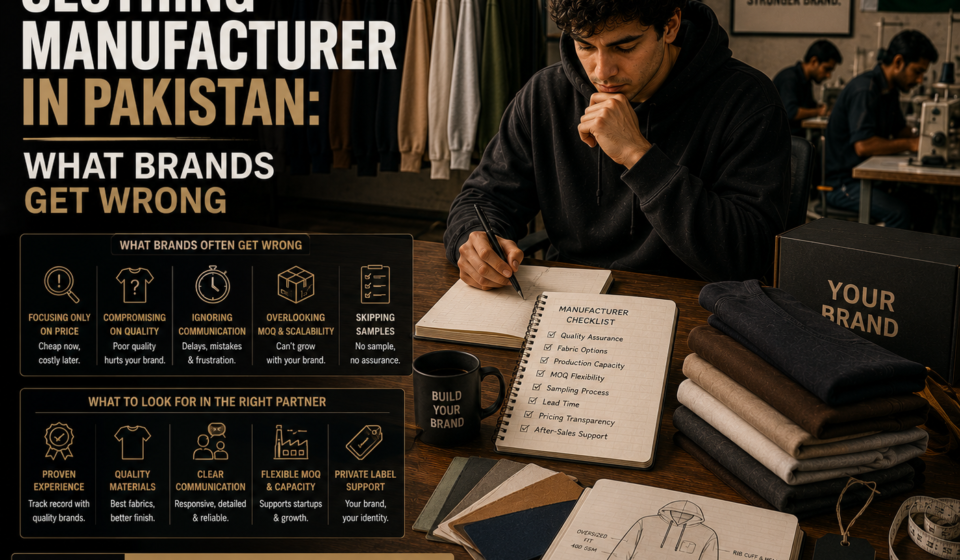
Mistake #1: Choosing a Manufacturer Based Only on Price
One of the biggest sourcing mistakes is requesting quotes from multiple factories and selecting the cheapest option.
Low pricing may indicate:
- Lower fabric quality
- Limited quality control
- Inexperienced production teams
- Poor finishing standards
Instead, compare overall value, including:
- Fabric quality
- Construction
- Communication
- Sampling process
- Production consistency
A slightly higher production cost often results in fewer defects and happier customers.
Mistake #2: Not Asking About In-House Production
When learning how to choose a clothing manufacturer in Pakistan, ask whether production is handled internally or outsourced.
Factories with integrated manufacturing often provide better control over:
- Fabric knitting
- Dyeing
- Cutting
- Sewing
- Printing
- Embroidery
- Quality inspection
Fewer third-party suppliers usually mean greater consistency.
Mistake #3: Ignoring Sampling and Wash Testing
Never approve production based only on appearance.
Ask manufacturers whether they perform:
- Wash testing
- Shrinkage testing
- Colorfastness testing
- Fabric GSM verification
- Measurement checks
A premium-looking sample can still fail after washing if these tests are skipped.
Mistake #4: Not Asking About Minimum Order Quantities (MOQs)
Every manufacturer has different production requirements.
Ask:
- What’s the minimum order per color?
- Can you produce samples?
- Do MOQs change with custom fabrics?
- Are mixed-size runs available?
Choosing the right MOQ helps avoid unnecessary inventory.
Mistake #5: Forgetting About Communication
Even the best factory can become difficult to work with if communication is slow or unclear.
Evaluate:
- Response times
- Technical knowledge
- Willingness to answer questions
- Production updates
- Problem-solving approach
Good communication often predicts a successful manufacturing relationship.
Mistake #6: Not Checking Product Specialization
Not every factory produces every garment equally well.
Some specialize in:
- Luxury fashion
- Sportswear
- Denim
- Knitwear
- Streetwear
- Performance apparel
If your brand focuses on heavyweight hoodies, oversized T-shirts, or premium sweatshirts, choose a manufacturer with proven experience in those categories.
For example, manufacturers such as Loopback Apparel specialize in heavyweight cotton apparel, private-label production, and premium streetwear blanks, making them well suited for brands building long-term collections rather than one-off merchandise.
Questions to Ask When Learning How to Choose a Clothing Manufacturer in Pakistan
Before making a decision, ask:
- Do you manufacture in-house?
- Can I see previous work?
- What certifications do you hold?
- Do you offer fabric customization?
- Can you produce custom labels and packaging?
- What quality checks are completed before shipment?
- What are your lead times?
- Can you support future growth?
The answers reveal far more than pricing alone.
Why the Right Manufacturing Partner Matters
The manufacturer you choose becomes an extension of your brand.
Customers judge your business by:
- Fabric quality
- Fit
- Durability
- Printing
- Stitching
- Packaging
Finding the right manufacturing partner helps maintain consistency across every collection.
Final Thoughts
Knowing how to choose a clothing manufacturer in Pakistan isn’t about finding the lowest quote it’s about finding the right partner.
Evaluate manufacturers based on quality, transparency, communication, and expertise rather than price alone.
Pakistan offers exceptional opportunities for clothing brands, especially those focused on premium cotton apparel and modern streetwear. By taking time to evaluate manufacturers carefully, you build a stronger foundation for long-term success.
Frequently Asked Questions
Is Pakistan a good country for clothing manufacturing?
Yes. Pakistan is one of the world’s largest textile producers and is known for premium cotton, knitwear, competitive pricing, and vertically integrated manufacturing.
Why do clothing brands manufacture in Pakistan?
Brands choose Pakistan for its textile expertise, access to quality cotton, skilled workforce, and ability to produce premium garments at competitive costs.
How do I verify a clothing manufacturer in Pakistan?
Request production samples, review previous work, ask about certifications, check references, and discuss quality control procedures before placing an order.
What products are commonly manufactured in Pakistan?
Pakistan is particularly known for hoodies, sweatshirts, T-shirts, joggers, sportswear, knitwear, and private-label apparel.
What should I ask before placing my first production order?
Ask about MOQs, sampling, lead times, quality testing, customization options, payment terms, and production capacity.