Clothing Manufacturing Comparison 2026: Pakistan vs China vs Portugal (7 Honest Truths)

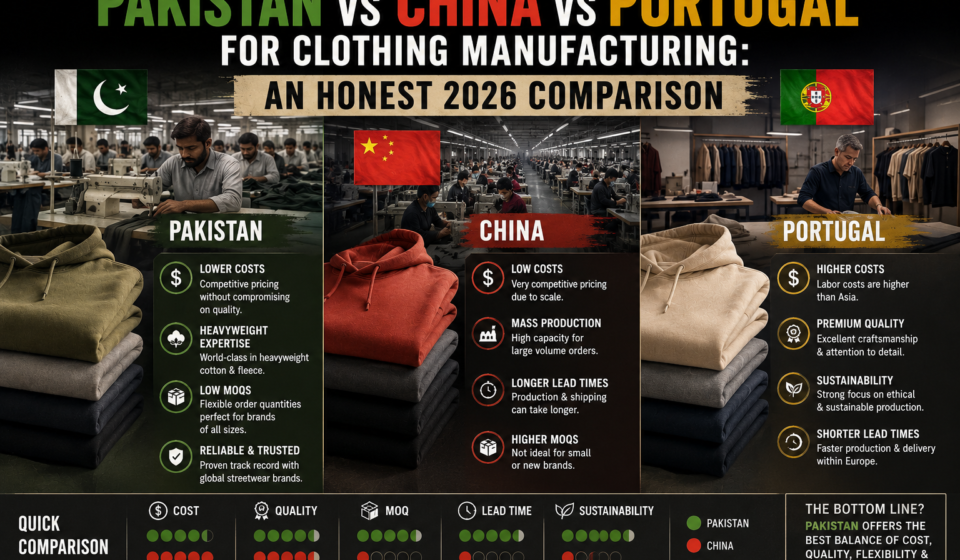
Pakistan vs China vs Portugal for Clothing Manufacturing: An Honest 2026 Comparison
A fair Clothing Manufacturing Comparison between Pakistan, China, and Portugal has never mattered more. Tariff shocks, rising Asian wages, and the “Made in Europe” premium have scrambled the old assumption that cheap always means China. If you’re a brand founder choosing a production base in 2026, the right answer depends less on headline price and more on order size, product complexity, and how fast you need stock on shelves. This Clothing Manufacturing Comparison breaks down the real trade-offs no sales pitch, just numbers.
Why This Clothing Manufacturing Comparison Matters in 2026
Sourcing decisions used to be simple: China for scale, everyone else as a backup. That’s no longer true. China’s share of world clothing exports fell to 29.6% in 2024, its lowest level since 2010, while combined US tariffs on many Chinese apparel categories reached roughly 35% by late 2025. Meanwhile, a growing number of brands, particularly European ones, are shifting part or all of their production to Portugal for reasons that go beyond price. Any honest Clothing Manufacturing Comparison in 2026 has to weigh labor cost, tariffs, lead time, and compliance together not in isolation.
Pakistan: The Low-Cost, High-Risk Option
Pakistan remains one of the cheapest places on earth to cut and sew a garment. Pakistan’s federal minimum wage sits at PKR 37,000 per month (roughly $132) as of 2026, and Pakistani textile wages average between $135 and $140 per month, among the lowest in the global garment industry. That cost advantage is real, but so are the risks: the ILO estimates that 30-40% of formal-sector workers in Pakistan earn below the legal minimum wage despite having formal contracts, and enforcement is uneven across provinces.
For brands prioritizing rock-bottom cost per unit on basic, high-volume items (think plain tees, denim, basic knitwear), Pakistan is competitive with Bangladesh and India. But quality consistency, compliance documentation, and longer lead times (often 8-12 weeks) mean it suits large, simple orders better than fast-turnaround or premium product lines. If your brand story leans on ethical sourcing claims, Pakistan requires more third-party auditing to back that up credibly.
China: Scale and Speed, at a Tariff Cost
No Clothing Manufacturing Comparison is complete without China, still the world’s largest apparel exporter. China shipped $165.24 billion in apparel exports in 2024, and its supply chain remains unmatched for complexity, fabric variety, and factory capacity. Chinese factories offer massive production capacity and can handle high-volume orders with quick turnaround times, backed by decades of vertically integrated infrastructure.
The catch is cost creep from tariffs, not labor. Average Chinese manufacturing labor cost now runs around $6.50 per hour no longer the bargain it was a decade ago and Section 301 tariffs mean a US brand ordering 5,000 cotton hoodies annually from China now pays roughly $4,260 a year in duties alone. The average US apparel tariff jumped from 14.7% to 35.1% within eleven months, and import volumes dropped a fifth almost immediately. China still wins on raw per-unit pricing and MOQ flexibility for scale, but the total landed cost story looks very different than it did five years ago.
Portugal: Premium Quality, EU Compliance, Small Runs
Portugal sits at the opposite end of this Clothing Manufacturing Comparison. Portugal’s production costs are higher than China’s due to higher labor wages, advanced manufacturing techniques, and strict labor regulations, but that premium buys something specific: consistency, EU compliance, and speed to European markets. Portuguese factories are typically small, often 10-50 workers, which allows for hands-on quality management and generational expertise in knitwear and jersey.
Portugal also wins where China structurally can’t: there are no customs duties on EU-made goods sold within Europe, versus a 12% duty on Chinese garment imports, and Portuguese MOQs of 50-100 pieces reduce inventory risk compared to Chinese MOQs of 500-1,000+. For small-batch, premium, or fast-fashion-response brands selling into Europe, Portugal’s shorter supply chain often beats China on total cost even before factoring in quality and returns.
Head-to-Head: Cost, Speed, and Compliance
| Factor | Pakistan | China | Portugal |
|---|---|---|---|
| Labor cost | Lowest (~$135-140/mo) | Mid (~$6.50/hr) | Highest, but 18-25% of total CMT |
| Typical MOQ | Large batches | 500-1,000+ units | 50-200 units |
| Lead time | 8-12 weeks | 6-10 weeks + shipping | 3-5 weeks to EU |
| Tariff exposure (US) | Moderate | High (~35%) | Low (EU domestic) |
| Best for | Basic, high-volume goods | Scale, complex fabrics | Premium, small-batch, EU-bound |
Which Country Wins This Clothing Manufacturing Comparison?
There’s no single winner that’s the honest answer. Pakistan wins on raw unit cost for simple, high-volume basics if you can manage quality risk. China wins on scale, fabric range, and manufacturing infrastructure, provided your margins can absorb tariff exposure into the US. Portugal wins on speed-to-market, EU compliance, and small-batch flexibility, especially for brands selling to European customers who care where their clothes are made.
If you’re weighing this decision for your own brand, start by mapping your order volume and target market against the table above it usually narrows the choice to one country fast. For a deeper breakdown of landing costs and duty calculations, see our apparel sourcing and cost guide, and if MOQ negotiation is your sticking point, our factory negotiation playbook walks through real scenarios.
Where Loopback Apparel Fits Into This Clothing Manufacturing Comparison
Once you’ve picked a country on paper, the harder part is finding a reliable partner on the ground vetting factories, negotiating MOQs, and managing quality across a supply chain you can’t visit every week. That’s the gap Loopback Apparel works in day to day, handling both custom clothing manufacturing for brands with their own designs and specs, and blank apparel for labels that want to build on proven base garments. Whichever country ends up matching your order size and margins, it’s worth talking through the specifics with a sourcing partner before locking in a factory.
Resources for Further Reading
Whichever way you lean, treat this Clothing Manufacturing Comparison as a starting point, not a final answer get physical samples from at least two countries before committing to a production run.