
Best Blank Hoodies for Clothing Brands: What to Look For
Choosing the best blank hoodies for clothing brands isn’t simply about finding the cheapest wholesale hoodie.
The blank hoodie becomes the foundation of your finished product.
Its fabric determines the hand feel. Its GSM affects weight and structure. Its fit determines the silhouette. Its construction affects durability. And its consistency determines whether customers receive the same product every time they order.
For streetwear brands in particular, the wrong blank can make an otherwise excellent design feel generic.
The right blank can become the foundation of an entire collection.
So, what should clothing brands actually look for when sourcing blank hoodies?
What Is the Best Blank Hoodies for Clothing Brands ?
A blank hoodie is an undecorated hoodie manufactured without a brand’s final graphics or customization.
Brands can purchase blank hoodies and add their own:
- Screen printing
- DTG printing
- DTF printing
- Embroidery
- Private labels
- Hang tags
- Custom packaging
- Other branding elements
Blank hoodies allow brands to focus on design and branding without necessarily developing the entire garment from scratch.
For startups, this can reduce product-development complexity and allow them to test products before investing in fully custom manufacturing.
What Makes a Blank Hoodie Good for a Clothing Brand?
A good blank hoodie should already feel like a finished product before you add your logo.
Look at:
- Fabric quality
- GSM
- Fiber composition
- Fit
- Construction
- Ribbing
- Stitching
- Shrinkage
- Color consistency
- Customization compatibility
- Size consistency
If the blank feels cheap before customization, printing an expensive graphic won’t fix the underlying product.
Your brand is ultimately attached to the garment.
1. Start With Fabric Weight and GSM
One of the first specifications clothing brands should check is GSM, which means grams per square meter.
GSM measures fabric weight.
A higher GSM generally indicates a heavier fabric when comparing similar constructions.
For streetwear brands, heavyweight hoodies can provide the substantial feel and structured silhouette customers often associate with premium apparel.
However, GSM should never be the only quality measurement.
A 500 GSM hoodie isn’t automatically better than a 450 GSM hoodie.
Fabric construction, fiber composition, yarn, finishing, fit, and stitching all matter.
Think of GSM as a specification—not a quality score.
2. Choose the Right Fabric Composition
The fabric composition affects how the hoodie feels and performs.
Common options include:
Cotton
Cotton provides a natural hand feel and is widely used in premium apparel.
Cotton/Polyester Blends
Blends can offer different combinations of durability, softness, shape retention, and performance.
Fleece
Fleece typically features a soft interior designed for warmth.
Loopback
Loopback fabric has looped yarns on the inside rather than the brushed interior associated with fleece.
The right fabric depends on the product you want to create.
Don’t choose based solely on a supplier saying “premium cotton.”
Ask for the actual composition and fabric specifications.
3. Look at the Fit
A blank hoodie can have excellent fabric and still be wrong for your brand.
Fit is particularly important in streetwear.
Common silhouettes include:
- Regular fit
- Relaxed fit
- Oversized
- Boxy
- Drop shoulder
- Cropped
If your brand sells oversized streetwear, you need to examine actual measurements.
Don’t rely on the word “oversized.”
Check:
- Chest width
- Body length
- Shoulder width
- Sleeve length
- Sleeve opening
- Hood dimensions
- Hem width
An intentionally oversized hoodie should have balanced proportions rather than simply being a regular hoodie made several sizes larger.
4. Check the Hood Construction
The hood is one of the first things customers notice.
A premium hoodie should have a hood that complements the weight and silhouette of the garment.
Look at:
- Hood depth
- Hood width
- Drawcord construction
- Seam quality
- Layering
- Shape retention
A heavyweight body paired with a thin or poorly structured hood can make the garment feel unbalanced.
For streetwear, a substantial hood can contribute significantly to the overall appearance.
5. Don’t Ignore the Ribbing
The cuffs and waistband need to work with the weight of the hoodie.
Good ribbing should:
- Recover after stretching
- Hold its shape
- Feel substantial
- Match the garment
- Remain consistent after washing
Weak ribbing can cause a heavyweight hoodie to lose its shape and make the garment look worn prematurely.
Check both the cuff and bottom hem when evaluating samples.
6. Inspect the Stitching
Construction quality is another major factor.
Turn the hoodie inside out and inspect it.
Look at:
- Shoulder seams
- Armholes
- Side seams
- Hood seams
- Cuffs
- Waistband
- Pocket construction
Look for consistent stitching and clean seam finishing.
A product can have excellent fabric and still fail because of poor construction.
7. Check Shrinkage Before Production
Cotton garments can change dimensions after washing.
This is particularly important for oversized clothing.
Imagine approving a hoodie based on a perfect sample and then discovering after production that the body length has changed significantly after washing.
Always wash-test your sample.
Measure the garment:
Before washing
and
After washing
Compare:
- Chest
- Length
- Shoulder
- Sleeve
- Cuff
If shrinkage occurs, your final size chart should account for it.
8. Choose a Blank That Works With Printing
If you’re buying blank hoodies for a clothing brand, decoration compatibility matters.
Your blank should work with your intended customization method.
Common options include:
Screen Printing
Good for many bold graphics and larger production runs.
DTG
Useful for detailed digital artwork and certain suitable cotton garments.
DTF
Provides flexibility for detailed graphics and can work across a wider range of garment types.
Embroidery
Useful for logos, lettering, and smaller branded elements.
Don’t assume that every blank hoodie works equally well with every printing method.
Test the actual garment.
9. Consider Private Label Support
If you’re building a serious clothing brand, you may eventually want more than a printed logo.
Private labeling can include:
- Custom neck labels
- Woven labels
- Printed labels
- Hang tags
- Custom packaging
- Branded bags
This creates a more cohesive customer experience.
Instead of selling a generic blank with your artwork added, you can create a product that feels like it belongs entirely to your brand.
10. Evaluate MOQ
MOQ means Minimum Order Quantity.
It is the smallest quantity a supplier requires you to order.
MOQ is particularly important for startups.
A supplier might require:
- 50 pieces
- 100 pieces
- 300 pieces
- 500 pieces
- 1,000+ pieces
But the important question is how the MOQ is calculated.
Does the minimum apply to:
- Each color?
- Each size?
- Each style?
- Each custom fabric?
- The entire order?
Always clarify this before placing an order.
11. Compare More Than Unit Price
The cheapest blank hoodie isn’t necessarily the cheapest product for your brand.
Consider the complete landed cost:
Garment + customization + labels + packaging + shipping + duties + fulfillment
A cheap hoodie that produces high return rates or inconsistent sizing can become significantly more expensive.
Instead, evaluate the relationship between:
Quality → Cost → Customer perception → Margin
The best blank is the one that gives your brand the right combination.
12. Consistency Is Critical
One sample can look perfect.
That doesn’t guarantee your next 500 hoodies will look identical.
Ask the supplier how they maintain consistency between production batches.
Important specifications include:
- GSM
- Fabric composition
- Measurements
- Color
- Stitching
- Ribbing
- Hood construction
For a growing clothing brand, repeatability is extremely important.
Customers expect the hoodie they buy next season to feel like the hoodie they purchased previously.
Best Blank Hoodies for Different Types of Brands
There isn’t one best blank hoodie for every business.
For Streetwear Brands
Look for:
- Heavyweight fabric
- Oversized or boxy fit
- Drop shoulders
- Substantial ribbing
- Structured hood
- Strong construction
For Graphic Brands
Prioritize:
- Suitable printing surface
- Consistent fabric
- Compatible fiber composition
- Stable sizing
For Startup Brands
Prioritize:
- Lower MOQ
- Sample availability
- Customization
- Private labeling
- Reasonable pricing
- Consistent quality
For Premium Brands
Prioritize:
- Fabric quality
- Construction
- Fit
- Finishing
- Custom development
- Repeat-order consistency
How to Test a Blank Hoodie
Before ordering hundreds of pieces, test one.
Step 1: Inspect the garment
Look at fabric, stitching, hood, cuffs, hem, and pocket.
Step 2: Measure it
Compare the physical garment against the supplier’s size chart.
Step 3: Wash it
Follow the intended care instructions.
Step 4: Measure again
Check for dimensional changes.
Step 5: Test your decoration
Apply your actual print or embroidery.
Step 6: Wear-test it
Evaluate comfort, fit, weight, and overall appearance.
Step 7: Review the final product
Ask yourself:
Would I be comfortable charging my customer my intended retail price for this hoodie?
If not, don’t place the bulk order.
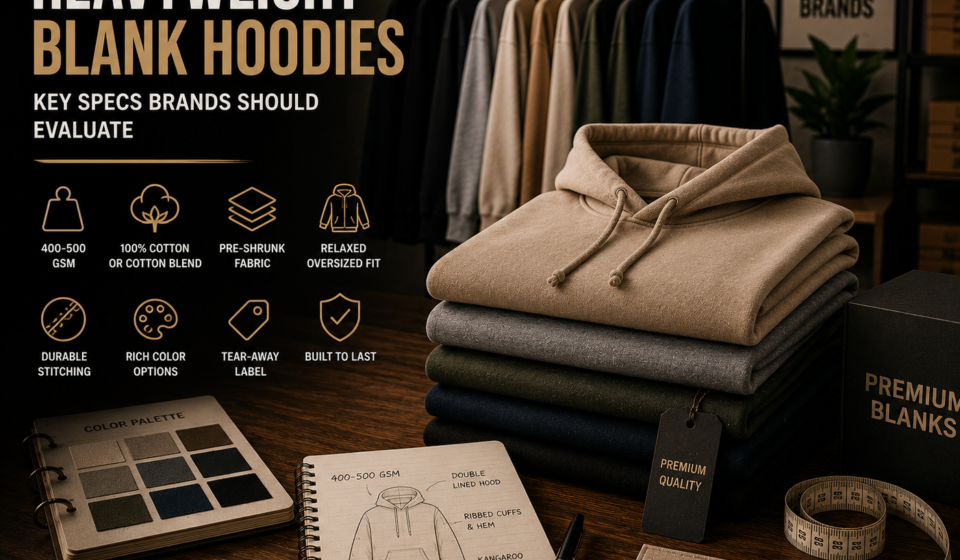
Heavyweight Blank Hoodies for Streetwear
For brands selling premium streetwear, heavyweight blanks can provide a stronger foundation for the final product.
A substantial hoodie can create the structured silhouette associated with contemporary streetwear while providing a premium hand feel.
Loopback Apparel specializes in streetwear-focused blanks, with selected hoodie products available in heavyweight constructions including 480 GSM options.
Depending on the product and project, brands can also explore customization options such as:
- Custom colors
- Printing
- Embroidery
- Private neck labels
- Custom sizing
- Custom packaging
The exact specifications and customization availability vary by product, so brands should evaluate the individual garment rather than assuming every hoodie has identical specifications.
Why Loopback Apparel Blanks Can Be a Strong Option
Loopback Apparel focuses on premium streetwear blanks designed around substantial fabrics and modern silhouettes.
The range includes heavyweight hoodies and other core streetwear garments intended for brands that want to customize, print, embroider, or private-label their products.
The goal is simple:
Give clothing brands a better blank to build on.
Instead of starting with a generic lightweight hoodie and relying entirely on graphics to create differentiation, brands can begin with the garment itself.
That means paying attention to fabric weight, fit, construction, and finishing before customization is even added.
Questions to Ask a Blank Hoodie Supplier
Before choosing your supplier, ask:
- What is the exact GSM?
- What is the fiber composition?
- What fabric construction is used?
- What is the hoodie fit?
- Can I get a measurement chart?
- What is the MOQ?
- Is MOQ per style or color?
- Can I order samples?
- Can you provide private labels?
- Can you add custom packaging?
- Is the hoodie compatible with DTG?
- Is it suitable for screen printing?
- Can you provide custom colors?
- What is the production lead time?
- How do you control quality?
- Can you maintain the same specifications on repeat orders?
The answers should be specific.
If a supplier can’t clearly explain the product they’re selling, that’s a warning sign.
Final Thoughts
The best blank hoodies for clothing brands aren’t necessarily the heaviest or the cheapest.
They’re the ones that match your brand’s product strategy.
Look at the complete garment:
Fabric → GSM → fit → hood → ribbing → stitching → shrinkage → customization → MOQ → consistency.
For a startup, choose a blank that allows you to test demand without taking unnecessary inventory risk.
For an established brand, prioritize repeatability and product differentiation.
And before placing a large order, always test the actual garment.
Because once your logo is attached to the hoodie, your customer doesn’t care who manufactured the blank.
They care whether the hoodie feels good, fits well, looks premium, and survives repeated wear.
That’s why choosing the right blank is one of the most important decisions a clothing brand can make.