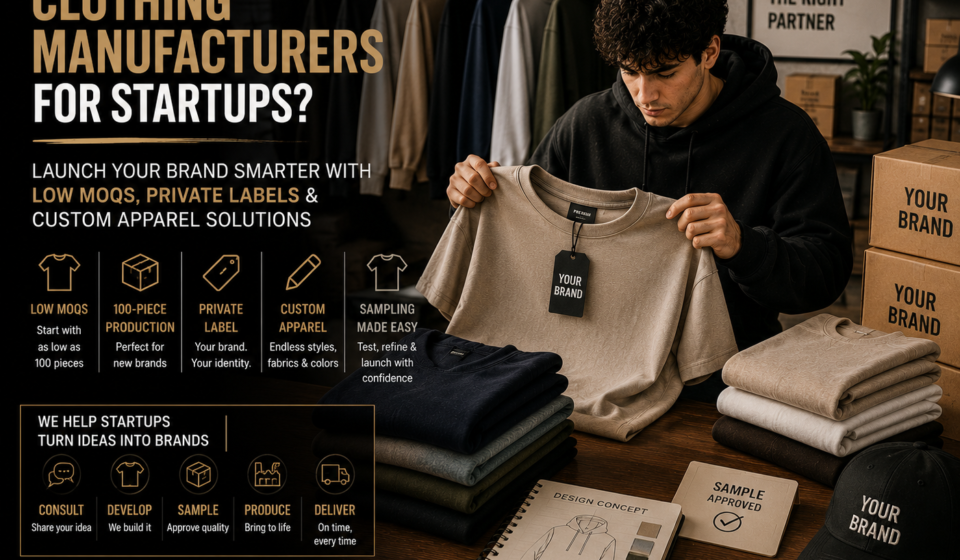

Clothing Manufacturers for Startups: Launch Your Brand With 100-Piece MOQ & Private Label Support
Starting a clothing brand sounds simple until you reach the manufacturing stage.
You have a product idea, a brand name, designs, and perhaps an audience waiting for the launch. Then you contact manufacturers and discover that some require large minimum order quantities, complicated production processes, or separate suppliers for labels, packaging, printing, and garments.
For a startup, that can create a difficult choice: order too much inventory and risk dead stock, or order too little and struggle to get the product manufactured at a reasonable cost.
That’s why low MOQ clothing manufacturers for startups can be valuable for new brands.
A manufacturer that supports smaller production runs and private-label services can allow a startup to test products, collect customer feedback, and build inventory without immediately committing to a large production run.
What Is a Low MOQ Clothing Manufacturers for Startups ?
MOQ means Minimum Order Quantity.
It refers to the minimum number of garments a manufacturer requires you to order for a particular production run.
For example, a manufacturer offering a 100-piece MOQ may allow a startup to produce 100 garments instead of requiring several hundred or several thousand pieces.
However, MOQ can be calculated differently by manufacturer.
A 100-piece MOQ might apply:
- Per style
- Per color
- Per design
- Per size
- Per production run
- Across a combined order
Always ask how the MOQ is calculated before placing an order.
Why Low MOQ Matters for Clothing Startups
Large production runs can create a major problem for a new clothing brand: inventory risk.
Imagine launching your first hoodie with a large order before you know whether customers actually want it.
If the product doesn’t sell, your cash is tied up in inventory.
A lower MOQ can reduce that initial risk.
Instead of committing your entire budget to one product, you can use a smaller production run to test:
- Product demand
- Pricing
- Fit
- Color
- Customer response
- Marketing
- Repeat purchase behavior
If the product performs well, you can scale production in a subsequent order.
This approach allows a startup to learn from real customers before making larger manufacturing commitments.
Can You Really Start a Clothing Brand With 100 Pieces?
Yes, depending on the manufacturer, product, customization requirements, and production specifications.
A 100-piece production run can be useful for testing a new product or launching a small initial collection.
However, don’t assume that every garment can be produced at exactly 100 pieces under every customization option.
MOQ can change depending on:
- Fabric
- Color
- Garment type
- Size breakdown
- Custom dyeing
- Printing
- Embroidery
- Private labels
- Packaging
- Production requirements
Before planning your launch around a specific MOQ, confirm the exact requirements with your manufacturer.
What Does Private Label Clothing Manufacturers for Startups Mean?
Private label manufacturing allows a brand to sell garments under its own branding rather than presenting the manufacturer as the consumer-facing brand.
Depending on the manufacturer and project, private-label services can include:
- Custom neck labels
- Woven labels
- Printed labels
- Hang tags
- Custom packaging
- Branded poly bags
- Custom colors
- Custom sizing
- Printing
- Embroidery
This can make a major difference for a startup.
Instead of purchasing generic garments and trying to build a brand around them, you can create a more cohesive customer experience from the beginning.
What Should a Startup Manufacturer Offer?
A good clothing manufacturers for startups should be more than someone who can sew a garment.
For a startup, look for a manufacturing partner that can support several stages of product development.
Sampling
You should be able to review samples before committing to bulk production.
Sampling allows you to evaluate:
- Fabric
- Fit
- Measurements
- Construction
- Color
- Stitching
- Branding
- Decoration
Production
The manufacturer should have a clear production process and realistic lead times.
Quality Control
Ask how garments are inspected before shipment.
Customization
Find out whether the manufacturer supports the customization your brand needs.
Private Labeling
If building a branded collection, ask whether labels and packaging can be integrated into production.
Communication
This is often overlooked.
A manufacturer that communicates clearly about samples, measurements, production, costs, and timelines can save a startup significant headaches.
Should Startups Use Blanks or Fully Custom Manufacturing?
There isn’t one correct answer.
It depends on what you’re trying to achieve.
Blank Apparel
Starting with premium blanks can be useful when you want to launch quickly.
You can customize:
- Graphics
- Printing
- Embroidery
- Labels
- Packaging
This can reduce product-development complexity.
It’s particularly useful for startups testing a concept before investing in fully custom garments.
Fully Custom Apparel
Fully custom manufacturing gives you more control over the garment itself.
You can develop:
- Fabric
- GSM
- Fit
- Measurements
- Colors
- Collar
- Cuffs
- Stitching
- Labels
- Packaging
This provides greater product differentiation but usually requires more development work and sampling.
For many startups, the best approach is to start with a strong blank or existing garment construction, validate demand, and move into deeper customization as the brand grows.
How Much Does It Cost to Manufacture 100 Clothing Pieces?
There is no universal price for a 100-piece production run.
The cost depends on the product and specifications.
Factors include:
- Garment type
- Fabric
- GSM
- Fabric composition
- Custom color
- Printing
- Embroidery
- Labels
- Packaging
- Number of sizes
- Pattern development
- Sampling
- Shipping
- Production location
For example, manufacturing 100 heavyweight hoodies with custom fabric and private labels will have very different costs from producing 100 lightweight T-shirts using an existing blank.
Don’t compare manufacturers using unit price alone.
Compare the total delivered product cost.
How to Choose a Clothing Manufacturer for Your Startup
Before choosing a supplier, create a shortlist and compare them systematically.
1. Check Their MOQ
Ask whether the MOQ applies per style, color, size, or total order.
2. Request a Sample
Never rely entirely on product photos.
Order a sample and inspect it yourself.
3. Review Fabric Specifications
Ask for:
- Fiber composition
- GSM
- Fabric construction
- Finishing
- Shrinkage information
4. Check the Fit
Measure the sample against the manufacturer’s size chart.
If you’re launching oversized apparel, pay particular attention to:
- Chest width
- Shoulder width
- Body length
- Sleeve length
- Sleeve opening
5. Ask About Private Labeling
Confirm whether your labels, hang tags, and packaging can be integrated into production.
6. Ask About Production Lead Time
Understand how long the manufacturer needs after sample approval and payment.
7. Understand Quality Control
Ask what happens if garments don’t meet the approved specifications.
Don’t Skip the Sample Stage
One of the most expensive mistakes a startup can make is moving directly from a product idea to bulk production.
A sample allows you to identify problems before they’re multiplied across an entire production run.
Check:
Fabric: Does it feel like the product you envisioned?
Fit: Does the garment actually fit your target customer?
Measurements: Are they consistent with your size chart?
Construction: Are seams, stitching, cuffs, collar, and hems properly finished?
Color: Does the actual garment match your approved color?
Customization: Does the print, embroidery, label, or branding look correct?
Wash performance: Does the garment shrink or change shape?
For cotton garments especially, washing the sample before production can reveal problems that aren’t visible when the garment is new.
Build a Size Breakdown Before Production
Ordering 100 pieces doesn’t mean ordering 100 identical garments.
You’ll need to determine how those pieces are distributed across sizes.
For example, your initial order could be divided among:
- Small
- Medium
- Large
- XL
- XXL
Your ideal size ratio depends on your target market and historical sales data.
If this is your first product and you have no sales history, avoid blindly ordering a large quantity in every size.
Start with realistic assumptions, then use your actual sales data to improve the next production run.
Low MOQ Doesn’t Mean Low Quality
Some brands assume that low MOQ automatically means the manufacturer is offering a lower-quality product.
That’s not necessarily true.
The more important questions are:
- What fabric is being used?
- What is the construction quality?
- How consistent is production?
- What quality-control process is used?
- What customization is available?
- Can the manufacturer reproduce the same garment on future orders?
A low MOQ is valuable because it can reduce inventory risk.
It shouldn’t require you to compromise on the product itself.
Why Private Label Support Matters
A startup clothing brand needs consistency.
If your garment, label, packaging, and customer experience all look unrelated, the brand can feel unfinished.
Private labeling allows you to build a more cohesive product.
Your garment can include:
Your brand name
Your neck label
Your size information
Your hang tag
Your packaging
Your custom graphics
This makes the final product feel like a genuine brand rather than a generic garment with a logo added afterward.
What Questions Should You Ask a Clothing Manufacturer?
Before placing your first order, ask:
- What is your MOQ?
- Is the MOQ per style or color?
- Can I order samples?
- What are your sample costs?
- What is the production lead time?
- What fabrics do you offer?
- Can you produce custom colors?
- Can you add private labels?
- Can you add hang tags?
- Can you provide custom packaging?
- Can you print or embroider garments?
- What quality-control process do you use?
- What happens if there are production defects?
- Can you reproduce the same product for future orders?
- What are your payment terms?
- How is shipping handled?
The manufacturer’s answers will tell you much more than a website claiming “premium manufacturing.”
Launching With 100 Pieces: A Practical Strategy
If you’re a new clothing brand, you don’t necessarily need to launch with a huge collection.
A smaller launch can be more strategic.
Step 1: Choose One Strong Product
Instead of launching ten products, start with one garment that represents the brand.
Step 2: Develop or Select the Right Blank
Choose the fabric, GSM, fit, and construction based on your target customer.
Step 3: Order a Sample
Inspect and wash-test it.
Step 4: Finalize Branding
Approve labels, hang tags, printing, embroidery, and packaging.
Step 5: Produce a Small Batch
A 100-piece MOQ, where available, can provide an opportunity to test the market without immediately overcommitting to inventory.
Step 6: Measure Demand
Track:
- Sell-through rate
- Conversion rate
- Best-selling sizes
- Best-selling colors
- Customer feedback
- Returns
- Repeat purchases
Step 7: Scale the Winner
Once you’ve identified a product that customers actually want, increase your next production order.
This is a much safer way to scale than producing large quantities based purely on assumptions.
Clothing Manufacturing for Startups at Loopback Apparel
Loopback Apparel works with clothing brands looking for premium streetwear blanks and apparel production solutions.
Our manufacturing approach is designed around brands that care about fabric quality, modern silhouettes, customization, and a finished product that feels like a real brand not a generic garment with a logo added afterward.
Depending on the product and project, brands can explore options including:
- Premium blank apparel
- Heavyweight hoodies
- Oversized T-shirts
- Crewnecks
- Sweatpants
- Custom colors
- Printing
- Embroidery
- Private neck labels
- Custom sizing
- Branded packaging
For startup brands, the goal isn’t simply to manufacture the largest possible order.
It’s to build a product you can confidently sell, test demand, learn from customers, and scale when the numbers justify it.
Final Thoughts
Finding the right clothing manufacturer for a startup can make the difference between a manageable first launch and an expensive inventory mistake.
A low MOQ can help reduce upfront inventory risk, while private-label support can give your products a more professional and cohesive brand identity.
But don’t choose a manufacturer simply because they advertise a 100-piece MOQ.
Look at the entire process:
Sample → fit → fabric → customization → quality control → production → delivery → repeatability.
If the manufacturer can support those steps while maintaining consistent quality, a small first production run can become the foundation for a much larger brand.
For startups, the objective isn’t to manufacture the most clothing.
It’s to manufacture the right clothing, prove that customers want it, and then scale what works.