
Apparel Supplier USA: How to Choose the Right Supplier for Your Brand
Finding the right apparel supplier in the USA can make a major difference when you’re building or scaling a clothing brand.
A supplier isn’t simply a company that sends you T-shirts or hoodies. The right supplier can affect your product quality, inventory levels, margins, delivery times, customer experience, and ability to scale.
For a startup, choosing an apparel supplier can be particularly difficult. You may need low minimum order quantities, premium blanks, private labeling, custom packaging, reliable quality, and fast access to inventory all without committing to massive production runs.
Before choosing a supplier, it’s important to understand exactly what type of apparel supplier your brand needs.
What Is an Apparel Supplier USA?
An apparel supplier in the USA provides clothing products to businesses, brands, retailers, creators, or other organizations.
Depending on the supplier, products may include:
- T-shirts
- Hoodies
- Crewnecks
- Sweatpants
- Shorts
- Jackets
- Blank apparel
- Custom apparel
- Private-label garments
- Printed apparel
- Embroidered apparel
Some suppliers sell finished products wholesale, while others manufacture garments according to a brand’s specifications.
The distinction matters because your ideal supplier depends on your business model.
What Types of Apparel Suppliers Are Available in the USA?
Not every apparel supplier USA operates the same way.
Wholesale Apparel Suppliers
Wholesale suppliers typically sell existing products to businesses at wholesale prices.
This can be a straightforward option if you want to stock products without developing garments from scratch.
Blank Apparel Suppliers
Blank apparel suppliers USA provide undecorated garments that brands can customize.
These products can be used for:
- Screen printing
- DTG printing
- DTF printing
- Embroidery
- Private labeling
- Custom branding
Blank apparel can be particularly useful for streetwear brands and startups that want to control their graphics and branding without developing every garment from scratch.
Private Label Apparel Suppliers
Private-label suppliers allow brands to sell garments under their own branding.
Depending on the supplier, this can include:
- Custom neck labels
- Woven labels
- Hang tags
- Custom packaging
- Custom colors
- Custom sizing
- Printing
- Embroidery
Custom Clothing Manufacturers
Custom manufacturers develop garments according to your specifications.
This provides more control over the final product but can involve additional sampling, development, minimum quantities, and production time.
What Does “USA Apparel Supplier” Actually Mean?
This is one of the most important questions to ask.
An apparel supplier USA operating isn’t necessarily manufacturing every garment in the United States.
A company may:
- Manufacture domestically
- Import garments
- Manufacture overseas and warehouse products in the USA
- Manufacture overseas and fulfill orders from a U.S. warehouse
- Source garments from multiple countries
These are very different supply chains.
If domestic manufacturing is important to your brand, ask specifically where the garments are manufactured.
If fast U.S. delivery is the priority, a supplier with inventory or fulfillment infrastructure in the USA may be more relevant.
Don’t assume “USA supplier” automatically means “Made in USA.”
Why U.S. Inventory Can Matter for Clothing Brands
For brands selling to American customers, having inventory in the USA can simplify fulfillment.
Potential benefits include:
- Faster domestic shipping
- Easier inventory management
- Lower international shipping complexity
- Easier returns
- Better customer experience
- More predictable delivery times
This can be particularly valuable for a growing e-commerce brand.
A supplier doesn’t necessarily need to manufacture in the USA to provide U.S.-based inventory or fulfillment.
The important thing is to understand where your products are stored and how orders are shipped.
How to Choose an Apparel Supplier in the USA
Don’t choose a apparel supplier USA simply because their catalog looks good.
Evaluate the supplier using several factors.
1. Product Quality
Start with the actual garment.
Look at:
- Fabric composition
- GSM
- Fabric construction
- Stitching
- Ribbing
- Fit
- Shrinkage
- Finishing
A product photo can’t tell you everything.
Request samples whenever possible.
2. Product Range
Consider whether the supplier has enough products to support your brand as it grows.
For example, if you’re building a streetwear collection, you may eventually need:
- Oversized T-shirts
- Heavyweight hoodies
- Crewnecks
- Sweatpants
- Shorts
- Outerwear
A supplier that can support multiple product categories may simplify your sourcing process.
3. MOQ
MOQ means Minimum Order Quantity.
A high MOQ can create significant inventory risk for a startup.
Look for suppliers that provide MOQs appropriate for your current stage.
A small initial order can allow you to test demand before committing to large quantities.
However, always clarify whether the MOQ applies per product, color, size, or total order.
4. Pricing
Don’t compare suppliers based only on unit price.
Consider the complete cost:
Product + customization + labels + packaging + shipping + duties + fulfillment
A supplier with a cheaper garment can become more expensive after all additional costs are included.
5. Customization
If you’re building a brand rather than simply reselling clothing, customization may be important.
Ask whether the supplier supports:
- Custom colors
- Printing
- Embroidery
- Private labels
- Custom sizing
- Hang tags
- Custom packaging
6. Quality Consistency
A good sample doesn’t guarantee consistent production.
Ask how the supplier manages quality control.
You want the garments you receive six months from now to remain consistent with the product you approved today.
What Is the Best Apparel Supplier for a Startup?
The best supplier for a startup isn’t necessarily the largest supplier.
A startup often needs flexibility more than scale.
Look for a supplier that can offer:
- Reasonable MOQs
- Sample orders
- Consistent quality
- Clear communication
- Transparent specifications
- Customization options
- Reliable production
- Predictable lead times
A supplier that understands smaller brands can be more useful than one designed exclusively around large corporate orders.
Blank Apparel vs Custom Apparel
One of the biggest decisions you’ll make is whether to purchase blanks or develop fully custom garments.
Blank Apparel
Blank garments can help you launch faster.
You purchase an existing garment and customize it with your own:
- Graphics
- Prints
- Embroidery
- Labels
- Packaging
This can reduce development time and upfront complexity.
For new brands, it can also be a practical way to test a product before investing in custom manufacturing.
Custom Apparel
Custom manufacturing gives you greater control.
You can specify:
- Fabric
- GSM
- Fit
- Measurements
- Color
- Collar
- Cuffs
- Stitching
- Labels
- Packaging
The trade-off is that custom development generally requires more time and sampling.
What Should You Ask an Apparel Supplier?
Before placing an order, ask the supplier:
- Where are the garments manufactured?
- Where is inventory stored?
- What is the MOQ?
- Is MOQ calculated per color or style?
- Can I order samples?
- What are the fabric specifications?
- What is the GSM?
- What is the fiber composition?
- What customization options are available?
- Can you provide private labeling?
- Can you provide custom packaging?
- What is the production lead time?
- What is the shipping time?
- How is quality control handled?
- What happens if there are defective garments?
- Can you support repeat orders?
- Can you provide consistent sizing between production batches?
A supplier’s answers can reveal whether they are actually suitable for your business.
Why GSM Matters When Buying Wholesale Apparel
GSM stands for grams per square meter and indicates fabric weight.
It’s particularly useful when comparing blank apparel.
For example, a lightweight T-shirt and heavyweight streetwear T-shirt may have dramatically different GSM values.
Higher GSM can provide a more substantial hand feel, but it doesn’t automatically mean higher quality.
Fabric construction, fiber quality, yarn, finishing, fit, and stitching matter too.
If you’re sourcing premium blanks, look at the complete specification rather than using GSM as the only quality metric.
How to Test an Apparel Supplier Before a Large Order
Never make your first decision based only on a catalog.
Use a sample-first approach.
Step 1: Order samples
Get the actual garments you intend to sell.
Step 2: Measure them
Compare the physical measurements against the supplier’s size chart.
Step 3: Inspect construction
Check seams, stitching, collar, cuffs, hems, and finishing.
Step 4: Wash-test them
Check for shrinkage, color changes, distortion, and fabric changes.
Step 5: Test customization
If you’re printing or embroidering, decorate the actual garment.
Step 6: Evaluate the finished product
Look at the product as a customer would.
Would you be comfortable putting your brand name on it?
If the answer is no, don’t scale the order.
Apparel Supplier USA for Streetwear Brands
Streetwear brands often have different sourcing requirements than traditional fashion retailers.
The garment itself is part of the design.
That makes specifications such as:
- GSM
- Oversized fit
- Drop shoulders
- Boxy proportions
- Heavyweight fabric
- Rib construction
- Garment finishing
particularly important.
A graphic printed on a generic lightweight T-shirt can create a completely different product from the same graphic printed on a heavyweight oversized blank.
If your brand sells premium streetwear, your supplier needs to understand the garment—not just the decoration.
Why Supplier Consistency Matters When You Scale
Imagine launching a successful hoodie.
Your customers love it.
Six months later, you reorder the same product and the fabric feels different, the measurements have changed, or the color isn’t consistent.
Now you have a brand problem.
Supplier consistency matters because customers expect the same product quality when they reorder.
Before scaling, ask suppliers about their ability to reproduce:
- Fabric weight
- Fabric composition
- Measurements
- Colors
- Construction
- Labels
- Packaging
A reliable supplier should be able to maintain specifications across production runs.
Loopback Apparel as an Apparel Supplier
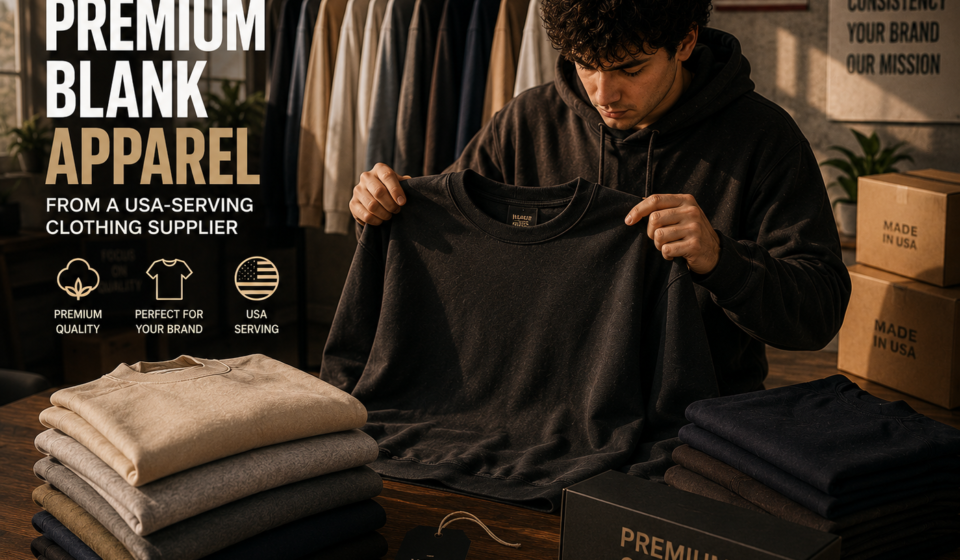
Loopback Apparel supplies premium streetwear blanks and apparel solutions for brands looking for substantial garments and modern silhouettes.
Our product range includes streetwear staples such as heavyweight hoodies, oversized T-shirts, crewnecks, and sweatpants.
Depending on the product and project, brands can explore customization options including:
- Custom colors
- Printing
- Embroidery
- Private neck labels
- Custom sizing
- Custom packaging
Loopback’s manufacturing is based in Pakistan, while inventory and fulfillment can support U.S. customers. This distinction matters: being a U.S. serving apparel supplier is not the same claim as saying every garment is manufactured in the United States.
For brands sourcing premium streetwear blanks, the goal is to combine substantial garment construction with the flexibility needed to build a recognizable product line.
Final Thoughts
Choosing an apparel supplier in the USA isn’t simply about finding the lowest wholesale price.
The right supplier should fit your brand’s current stage and future plans.
Evaluate:
Product quality → MOQ → customization → private labeling → inventory → fulfillment → quality control → consistency.
If you’re a startup, don’t rush into a huge order simply because the supplier offers a lower price at higher quantities.
Start with samples.
Test the garments.
Validate demand.
Then scale the products that customers actually want.
And if you’re comparing U.S. apparel suppliers, always ask one simple question before making assumptions:
Where is the garment actually manufactured, and where is it shipped from?
That answer can tell you more about a supplier’s supply chain than the words “USA apparel supplier” ever will.