
DTG Printed Hoodie: How DTG Printing Works & How to Choose a Hoodie
A DTG printed hoodie combines a comfortable hoodie with detailed, full-color artwork printed directly onto the fabric.
DTG, or Direct-to-Garment printing, has become a popular option for clothing brands, artists, creators, and custom apparel businesses because it can reproduce detailed artwork without requiring traditional screens for each color.
But the quality of a DTG printed hoodie doesn’t depend only on the printer.
The hoodie itself matters.
Fabric composition, fabric construction, surface texture, color, garment weight, pretreatment, artwork, curing, and washing can all influence the final print.
If you’re planning to sell DTG printed hoodies or looking for blanks suitable for DTG printing, here’s what you need to know.
What Is a DTG Printed Hoodie?
A DTG printed hoodie is a sweatshirt decorated using Direct-to-Garment printing.
Instead of transferring a design onto a separate film or applying vinyl, DTG printers deposit specialized textile inks directly onto the garment.
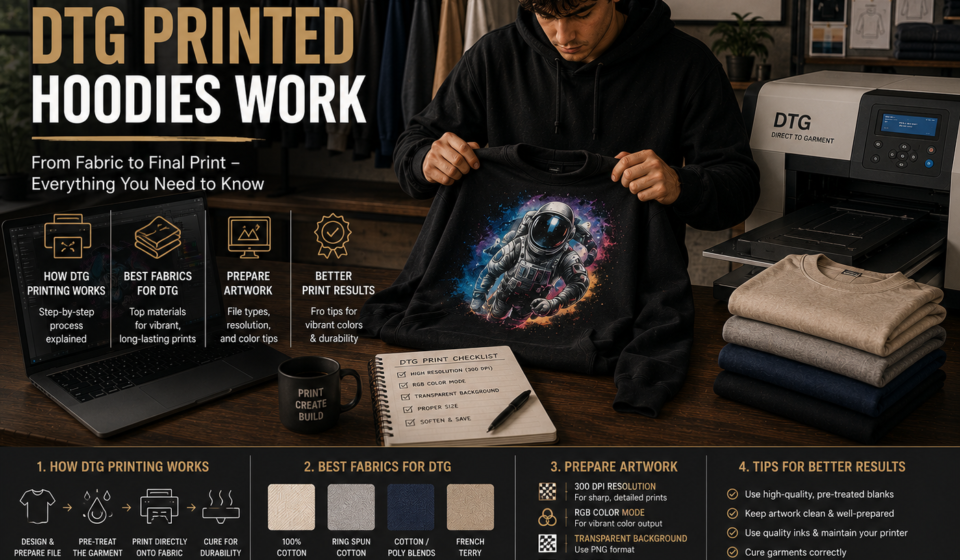
The process typically involves:
- Preparing the artwork
- Preparing and pretreating the hoodie
- Loading the garment into the printer
- Printing the design
- Curing or drying the ink
- Quality checking the finished garment
DTG is particularly useful for detailed designs containing gradients, illustrations, photographs, and multiple colors.
How Does DTG Printing Work on a Hoodie?
The process begins with digital artwork.
The design is prepared according to the printer’s requirements and the hoodie is positioned carefully on the printing platen.
For suitable garments, the fabric may be pretreated before printing.
The hoodie is then placed into the DTG printer.
The printer applies the ink directly onto the fabric.
For darker garments, a white ink layer may be used as a base before the color artwork is printed.
After printing, the garment must be properly cured so the ink bonds to the fabric.
The exact process varies according to the printer, ink system, garment, and production setup.
What Hoodies Are Best for DTG Printing?
The blank hoodie you choose can have a major impact on the final result.
For DTG printing, look for a garment with:
- A suitable fiber composition
- A consistent fabric surface
- Appropriate fabric density
- Minimal surface irregularities
- Consistent sizing
- Good construction
- A surface compatible with the printer and ink system
Cotton garments are commonly used for DTG printing because water-based textile inks can work well with cotton fibers.
However, you should always test the specific hoodie with the exact DTG process you plan to use.
Can You DTG Print on a Heavyweight Hoodie?
Yes, but the fabric weight itself isn’t the only consideration.
A heavyweight hoodie can be used for DTG printing if the fabric and surface are compatible with the particular DTG process.
A heavyweight hoodie can also provide a premium foundation for a printed garment because the finished product combines substantial fabric with detailed artwork.
However, don’t assume:
Higher GSM = better DTG print.
Print quality depends on factors including:
- Fiber content
- Fabric surface
- Pretreatment
- Ink
- Printer settings
- Curing
- Artwork
- Garment color
If you’re using a heavyweight blank, test it before production.
Why Cotton Matters for DTG
Fiber composition is one of the first specifications to check.
DTG inks are formulated for specific textile surfaces, and cotton is commonly used for direct-to-garment printing.
Before ordering a blank hoodie for DTG, check:
What is the fiber composition?
Don’t rely on the phrase “cotton feel.”
You want the actual fiber composition and construction.
If you’re developing a clothing brand, request a technical specification sheet whenever possible.
White vs Dark Hoodies for DTG
The garment color can affect the DTG process.
White and Light Hoodies
Light garments can make the printing process relatively straightforward because the fabric itself provides a light background.
Colors can appear differently depending on the garment and ink system.
Black and Dark Hoodies
Dark garments typically require additional preparation because the artwork needs to remain visible against the darker fabric.
White ink is commonly used as an underbase.
This can affect:
- Ink consumption
- Print feel
- Production time
- Color appearance
- Final texture
Dark garments should therefore be tested carefully before production.
What Artwork Works Best for DTG Hoodies?
One of DTG’s biggest advantages is its ability to reproduce detailed digital artwork.
DTG can be useful for:
- Illustrations
- Photographic designs
- Gradients
- Detailed artwork
- Multi-color graphics
- Complex compositions
- Small-batch designs
Unlike screen printing, you don’t necessarily need to separate the design into individual screens for each color.
However, that doesn’t mean every artwork file will produce an excellent print.
The artwork still needs to be prepared correctly for the printing system.
What File Should You Use for DTG Printing?
The exact requirements depend on the printer and production setup.
However, high-resolution artwork is generally preferred.
Before sending your design to a printer, ask for its specifications regarding:
- Resolution
- Color profile
- File format
- Transparency
- Print dimensions
- Maximum print area
A high-resolution source file gives the printer more information to work with.
Avoid enlarging a small, low-resolution image and expecting it to become sharp.
DTG vs Screen Printing on Hoodies
Both methods can produce excellent apparel, but they work differently.
| Feature | DTG | Screen Printing |
|---|---|---|
| Artwork | Excellent for detailed designs | Excellent for bold graphics |
| Multiple colors | Easy to handle digitally | Requires screen separation |
| Small runs | Often suitable | Can involve setup costs |
| Photographic designs | Strong option | More complex |
| Large quantities | May be less efficient depending on setup | Often efficient |
| Individual customization | Convenient | Less convenient |
| Print feel | Can be relatively soft depending on process | Varies by ink and application |
The right method depends on your design, order quantity, garment, budget, and desired finish.
DTG vs DTF on Hoodies
DTG isn’t the only digital printing option.
DTF, or Direct-to-Film printing, involves printing artwork onto a special film and then transferring the design onto the garment using heat and pressure.
DTG prints directly onto the garment.
DTF can provide flexibility across different fabrics and garment types, while DTG can be particularly attractive for direct printing on suitable cotton garments.
The best method depends on the specific blank, artwork, production volume, and desired result.
How Does a DTG Printed Hoodie Feel?
One of the advantages of a well-executed DTG print is that it can feel integrated with the garment rather than creating the thick plastic-like feel associated with some other decoration methods.
However, print feel depends on:
- Ink
- Pretreatment
- Design coverage
- Fabric
- Garment color
- Printer settings
- Curing
A large, heavily printed design can naturally feel different from a small chest logo.
If print hand feel matters to your brand, test the final product rather than relying solely on a supplier’s description.
How Durable Is a DTG Printed Hoodie?
DTG print durability depends heavily on production quality and garment care.
Poor pretreatment, incorrect curing, unsuitable fabric, or aggressive washing can reduce print performance.
To help preserve a DTG printed hoodie:
- Follow the garment’s care instructions
- Avoid unnecessarily high washing temperatures
- Turn the hoodie inside out when washing
- Avoid harsh washing conditions
- Follow the printer’s recommended curing process
For a clothing brand, conduct your own wash test before selling a new DTG printed product.
How to Wash a DTG Printed Hoodie
Always follow the specific care instructions supplied with your garment and printing system.
As a general approach, many printed garments benefit from gentler washing.
Turn the hoodie inside out before washing to reduce direct friction against the printed surface.
Avoid treating a printed hoodie like a work garment that needs aggressive washing.
The exact recommended care instructions should come from the manufacturer or printer because different inks, pretreatments, and garments can behave differently.
How to Test a Hoodie Before DTG Production
If you’re a clothing brand, don’t skip this stage.
Order one blank hoodie and test your exact printing process.
Step 1: Check the fabric
Confirm fiber composition, GSM, construction, and surface texture.
Step 2: Test the artwork
Print the actual design you plan to sell.
Step 3: Check print quality
Look at:
- Detail
- Color
- Edges
- Coverage
- Print placement
- Texture
Step 4: Wash-test the hoodie
Wash it according to the intended care instructions.
Step 5: Inspect it again
Compare the garment before and after washing.
Look for:
- Cracking
- Fading
- Peeling
- Loss of detail
- Changes in hand feel
- Fabric distortion
This process is much more reliable than judging a DTG hoodie from a digital mockup.
Best Blank Hoodie for DTG Printing
There isn’t one universal “best” blank hoodie for DTG printing.
The best blank depends on your printing system and product requirements.
If you’re building a premium streetwear product, you may want:
- Substantial fabric
- Suitable cotton composition
- Consistent surface
- Oversized or relaxed fit
- Quality ribbing
- Durable construction
- Consistent sizing
Loopback Apparel offers heavyweight streetwear blanks designed for brands that want substantial garments for customization.
Selected Loopback products are available in heavyweight fabric weights, including 480 GSM options, while exact composition and specifications vary by product.
Always test the specific blank with your DTG printer before committing to bulk production.
DTG Printed Hoodies for Clothing Brands
DTG can be especially useful for brands testing new graphics.
Instead of committing to large quantities of one design, brands can use digital printing to produce detailed artwork with greater flexibility.
This can make DTG useful for:
- Limited collections
- Artist collaborations
- Small-batch drops
- Custom artwork
- Graphic streetwear
- Creator merchandise
- Product testing
For a startup, this can reduce the risk of producing large quantities of a design before knowing whether customers actually want it.
What Should You Ask a DTG Hoodie Supplier?
Before placing an order, ask:
- What fabric composition is the hoodie?
- What is the GSM?
- Is the hoodie compatible with DTG printing?
- Has the exact garment been tested with your ink system?
- What pretreatment is recommended?
- What curing process should be used?
- What print area is available?
- What file format does the printer require?
- What is the expected wash performance?
- Can you order a sample before bulk production?
These questions can help you avoid buying a blank that looks great but performs poorly during printing.
Final Thoughts
A DTG printed hoodie is only as good as the combination of the artwork, printing process, and blank garment.
DTG can be an excellent choice for detailed graphics, full-color artwork, small-batch production, and brands that want flexibility without traditional screen-print setup.
But don’t choose the hoodie based only on appearance.
Check the fiber composition, fabric construction, GSM, surface consistency, fit, and print compatibility.
Then test the actual garment.
Print your artwork.
Wash it.
Inspect it.
Only after the sample performs the way you expect should you move into larger production.
For clothing brands, the goal isn’t simply to find a hoodie that can be printed.
It’s to find a blank hoodie that makes the finished printed product feel premium from the fabric to the artwork.